Mom at Cape Cod National Seashore
- Monica Puerto

- Jan 6, 2022
- 8 min read

It has been on my wish list for a while to do a mother and daughter trip. Even before the pandemic, I knew it was precious to grow up having a mother. One of my best friends lost their mother to cancer and now as an adult making my own money, I knew it was time to start the first of many mother and daughter trips. The trip was originally supposed to occur pre-pandemic to go to Maine and Acadia National Park in May 2020. It was supposed to be the perfect gift to me for finishing another semester of graduate school while working, but life had other plans. Fast forward, post vaccines I then decided to try again in the summer of 2021. Except now all the Airbnbs in Maine were booked and much more expensive. I scrambled and was able to pull off an itinerary that turned into an epic road trip. Even though thankfully my mother is healthy, she had hip surgery at the young age of fifty so it actually was a blessing in disguise that we ended up doing our trip to Cape Cod instead of hiking through Acadia National Park. My mother loves the ocean so taking her to a different coast was intriguing to me. Also since I had a lot of time off in between jobs, I was able to do our trip for a week versus four days in Maine. In the end, things worked out even if it was not how I expected it to be which is something I learned again and again in this pandemic that is still raging on.
After I picked my mother up in Boston in my new leased hybrid (which had great gas mileage), which I drove all the way from Maryland (thank you friends for letting me stop halfway at your homes; shout out Dara, Circe, and Abby). We spent a couple of days in Boston before we proceeded to Cape Cod where we would stay four days. On the way, we stopped at Plymouth, MA, and Heritage Museum and Gardens in Sandwich, MA (which really made me crave a sandwich). The gardens were showcasing one of my mom's and I's favorite flower for their Hydrangea Festival. It also was one of my grandmother's favorite flowers, who recently passed away in Mexico. It was really special to be surrounded by all the different species of Hydrangeas whose colors ranged from purple, pink, blue, white, etc. It felt like being surrounded by the love of my grandmother in the form of the perfumed air of all the Hydrangeas. Whenever I thought of her I always felt warmth and that was what I felt in the presence of these hundreds of flowers on a sunny day. It felt like she was part of the trip.
We made our way to the Airbnb in Eastham, MA closer to the end of the peninsula. The Airbnb was a 3-minute drive to the Nauset Lighthouse. I chose Eastham since it was very well located to the visitor center, Nauset Lighthouse, Provincetown, and the National Gaurd Beach. Almost immediately upon arriving our host greeted us and was very keen on communicating how vigilant we have to be on keeping the door closed and the lights off unless we wanted a bug infestation in our private room and bath. We drove to Nauset lighthouse post-dinner. It was 8 pm and there was still sunlight since it was mid-July. Already stepping out of the parking lot, overlooking the cliffs it was very obvious how unique this National Seashore was. This would be my second National Seashore, the first Assateague Island National Seashore. Even though it was July it was still a bit cool and with the strong sea breeze, it was even cooler.
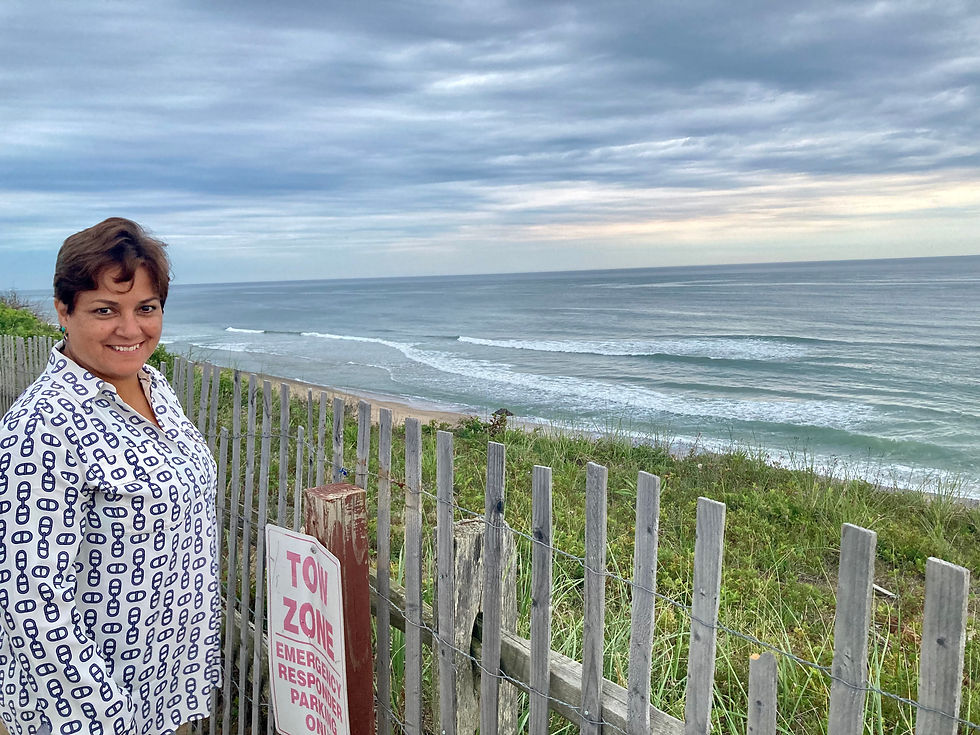
What caught our eyes immediately peering down the cliffs was how grave the erosion was against the towering sand cliffs and how no one was swimming even in July. Then we spotted seals bobbing up their heads continuously from the surface just as curious as the humans watching them down by the shore. I knew seals were great white shark's favorite food so I imagined the water down there must be very cold. We didn't go down and try that evening but later on the trip we would find out by dipping our feet into the water by the shoreline.
The next day we made our journey to Provincetown but first, we stopped at the Eastham Visitor Center.

I love visiting the Visitor Centers you learn so much from the exhibitions there and the best tips from the rangers. There we learned how most of Cape Cod was formed by glaciers 4,000 years ago and sea levels rise. Surrounding beaches at Eastham, Westfleet, Truro's current carried sand that deposited and created the tip of Cape Cod, Provincetown. Over time as soil formed, a forest formed which was what the Pilgrims encountered when they arrived first at Provincetown. When arriving at Eastham I was also surprised by the dense forests we passed coming up to the beach. Most of the beaches I grew up around did not have any forests surrounding them, it was just flat and open, but that's because Miami is very overdeveloped. It was not until I went to Assateague, Cape Cod, and later Hawaii that I had to go through dense forests and vegetation to arrive at a beach opening.
And so it begins, when the Pilgrims, or should we say invaders arrived in the 1620s. The ancestors of the Wampanoag natives have been traced to live in the area which is now known as Martha's Vineyards 10,000 years ago, as the natives referred to as Noepe. The Wampanoag tribe was spread around all of Southeastern Massachusetts and Eastern Rhode Island. Most of the Wampanoags perished in battle with the invaders over land. Since 1987, from the Settlement Act of Massachusetts, Congress acknowledges the Wampanoags and outlined 400 acres that were tribal lands that became partially reinstated because they were unjustly taken.
Depending on the season, the Wampanoags lived by the bay during the summer and in the winter lived by freshwater ponds. They stored food in large baskets such as dried corn, smoked meets, berries, nuts, and seeds in pits through the summer and fall. They were great farmers, and let the land dictate the crop and left the land unseeded in between crops to replenish the soil. I don't think the Wampanoags would ever imagine that hundreds of years post 'contact' the invaders would have to figure out a farming system to feed hundreds of millions which led to monocultures, poor soil health, the heavy reliance on pesticides, and foods mass-produced at a scale that are affordable but with less nutrition.
It only took less than 200 years for the Pilgrims to outnumber the Wampanoags who have been here for thousands of years. They learned a great deal from the natives. One of them was about whaling. And so it began the tug of war between the ecosystem and the colonists as their communities grew and they took from the land without replenishing. Whale oil was used for lightning, whalebone was used for clothing items, brushes, corsets, and almost anything of use of a flexible structure, and whale intestines were used in perfumes and hair powders. Today less than 300 right whales (given the name "right" because they floated after being killed so it was the right whale to kill), live in North America and are considered endangered worldwide.
We then arrived in Provincetown, where a few weeks later the Delta variant of COVID would take its first hold and we would learn that the virus has mutated enough to be transmissible from person to person despite vaccination status. However, the vaccines still were/are effective in reducing the likelihood of hospitalization especially in the older or vulnerable.

Provincetown I found out was actually where the Europeans first landed around this area, and then settled in Plymouth but came back to Provincetown to fish and trade. Plymouth Rock is one of the most popular tourist attractions of Plymouth but there is no evidence of the Pilgrims actually setting foot on the rock on display with 1620 carved in at the Pilgrim Memorial State Park, which was actually carved in 1880 according to signage at the site called Plymouth Waterfront. In 1902 the Cape Cod Pilgrim Memorial Association built the 252 granite bell tower on High Pole Hill so it was a taller and more prominent reminder than the rock, that the Pilgrims arrived here before Plymouth. The tower was influenced by the tower in Siena, Italy, the Torre del Mangia. You can go climb up the tower's 116 steps but it was closed due to COVID.
Before we visited the downtown of Provincetown we stopped at the Provinceland's Visitor Center and walked along the beach. The weather changes quickly around the beach, going from calm to windy and stormy in less than an hour. Beyond the dunes, we saw more curious seals, and this time up closer! They really do look like dogs of the sea.
The dunes were enormous and are another example of the story we continue to tell on how man reshapes the land without knowing better and then having to adapt to the land's reactions. 400 years ago we would be standing in a forest. The trees were used for building homes and ships. With nothing left to stabilize the ground, the winds stripped the topsoil away and left behind all the yellow sand, which would block doorways of houses. An adaptation to this, they would plant beach grass to stabilize the land in 1739. Without stability, the dunes would grow enormous and even move four meters a year which coined the term "walking dunes".
The next day we visited Coast Gaurd Beach, which landed as #10 on the Top 10 most beautiful beaches of United States by Dr. Beach and his 50 criteria points. Since it was a weekday, there were not a lot of visitors so we were able to get on the shuttle easily to the Coast Gaurd Beach. Later that night my mom and I took a sunset cruise, however with the heavy and common overcast there was no sunset to be seen, but it was fun to be on a boat and tour the Hyannis Harbor where JFK and his wife Jacqueline Kennedy spent many summers sailing and see their family boats among many other rich people's boats.





On the last day of the trip, we said goodbye to our beloved Nauset Lighthouse which we visited a handful of times over the trip.

Nearby less than half a mile were 3 lighthouses dubbed the "Three Sisters", which were the original lighthouses where Nauset Lighthouse stands now in the 1800s. In 1875 they constructed a house next to the lighthouses for the lighthouse keeper and his family to live in. The home is still there but now functions as a private residence since a lighthouse keeper was no longer needed when they automated the lighting in 1952. I learned that due to the fast-paced erosion, lighthouses and homes were relocated further inland a few times. The Highland Lighthouse pictured in the first picture of this blog post was moved in the summer of 1996 back 450 feet from its original position due to the likelihood of collapsing from the ever retreating land from erosion.

Before we left Cape Cod entirely, we were in luck and able to snag the last two spots of a guided National Park Ranger canoe talk about the ecosystem and the Eastham Visitor Center. It has been a while since we kayaked together, probably almost a decade but instead of Miami's waters, we were in a totally different place.



We had a great time at Cape Cod, and later Boston and Cambridge. It truly gave me so much joy to treat my mother on a trip. We made incredible memories and I know it will be the first of many to come. Love you Mami.
Thanks for reading!


Comments